
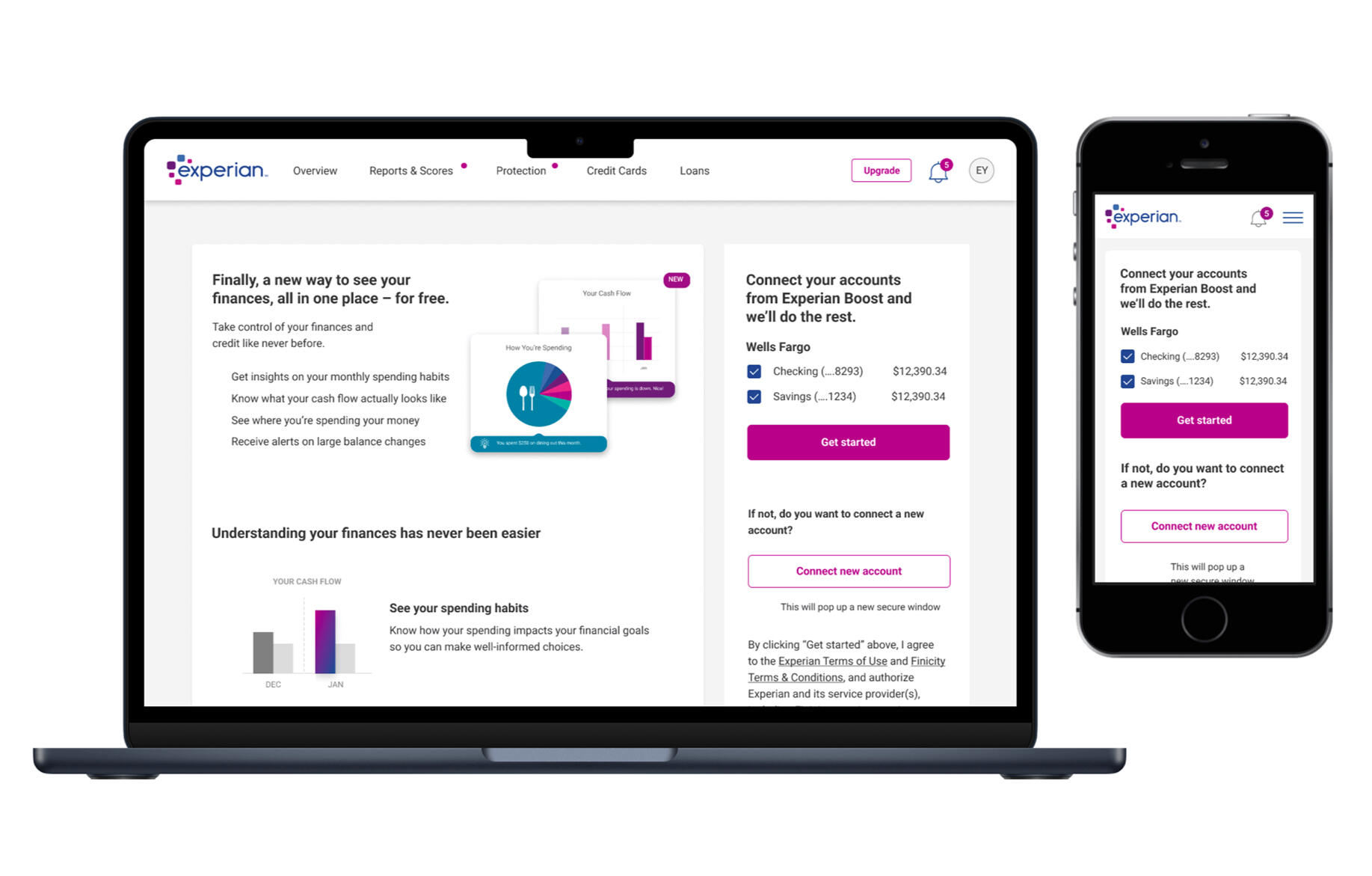
Making Personal Finances Easier to Understand and Manage
Personal Finances was a new product for Experian Consumer Services designed to give people a clearer view of their financial lives in one place.By connecting their financial accounts, users could review transactions, understand their spending, receive alerts, and find guidance to help them make more informed decisions about their money.
Design Lead | 2020 – 2021
I joined Personal Finances after a contract designer had begun exploring the concept through early wireframes. As Design Lead, I took over the experience and helped guide it through product definition, interaction and visual design, prototyping, testing, iteration, and beta launch.I partnered with another product designer and worked closely with Product, Engineering, Research, Content, and Experian's internal creative agency to shape the experience across desktop, tablet, and mobile web.
The Opportunity
How might we create a financial tool that's unified, easy to use, and helps people feel more confident managing their money?
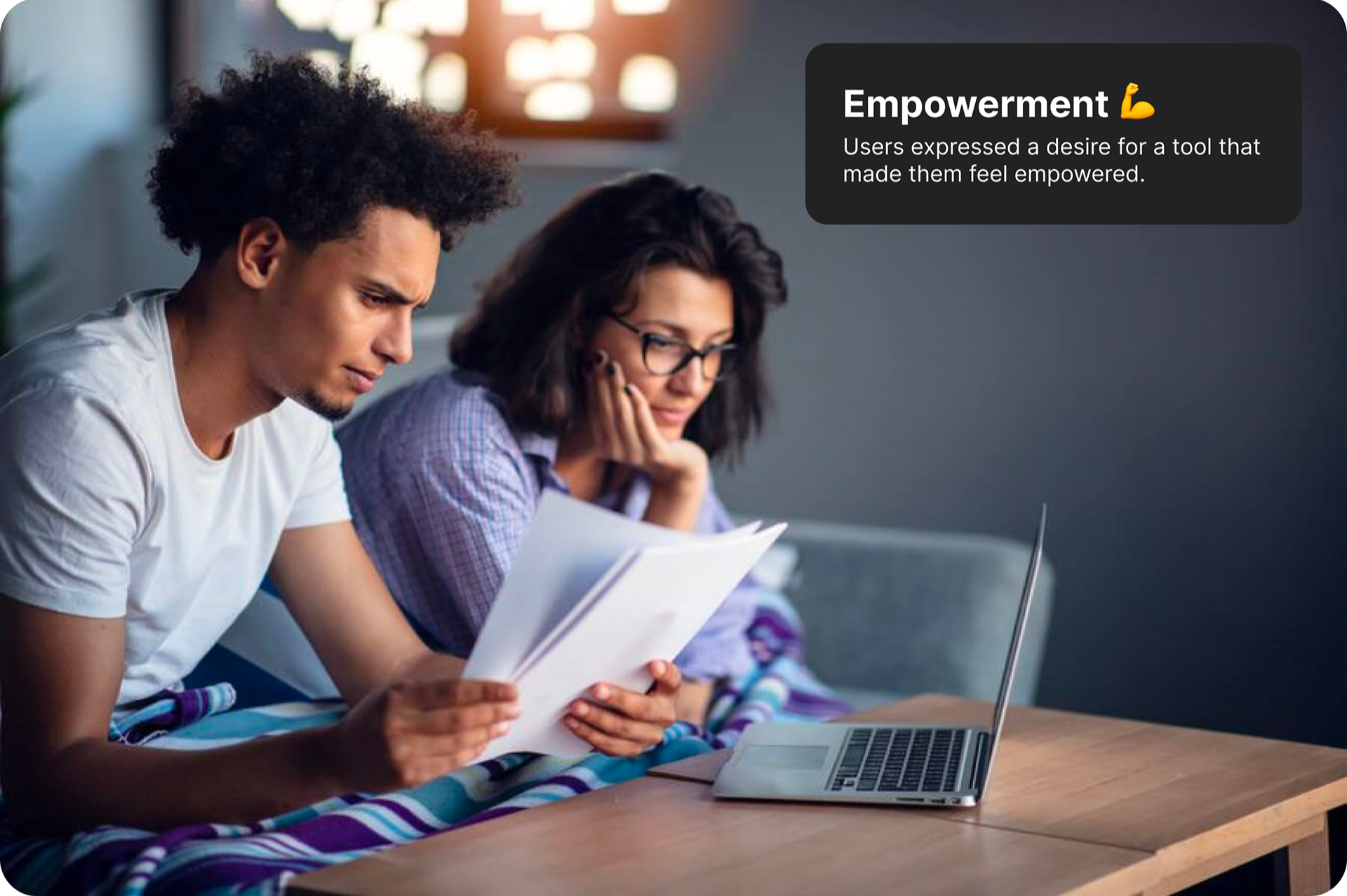
Research showed that managing finances could feel fragmented. People were navigating information across different accounts and services while looking for better ways to understand where their money was going.Our research highlighted three recurring needs: organization, financial understanding, and a greater sense of control. People wanted a more complete financial picture, but they also wanted an experience that could help them understand and act on what they were seeing.That gave us an opportunity to create something that went beyond displaying financial data and helped people feel a sense of empowerment.
Defining the Core Experience
When I joined, the product was still in an early stage with rough wireframes beginning to define what the experience could become. One of my first priorities was helping turn those explorations into a clearer end-to-end product experience.Research and competitive analysis helped us focus the experience around connecting financial accounts, viewing transactions in one place, understanding categorized spending, and receiving alerts about account activity.I developed task and user flows to map the journey from connecting an account and processing financial data through exploring the Personal Finances dashboard and individual transactions. Those flows gave the team a shared foundation for defining the MVP and moving into more detailed interaction and visual design.
Helping People Understand Their Spending
Bringing accounts together was only valuable if people could make sense of the information once it was there.We designed the experience around a consolidated view of transactions and spending categories allowing people to better understand where their money was going across connected accounts.We also explored contextual guidance within the experience so educational support could live closer to the financial information it related to. The goal was to make Personal Finances useful as both a financial overview and a tool for building greater financial understanding.


Learning Through Testing
Research remained part of the process as the product took shape.We tested an early experience with 12 participants across different credit segments and age groups. Participants responded positively to having their financial information brought together and highlighted the usefulness of seeing transactions, categorized spending, and alerts within the same experience.We continued testing more informally as the product evolved using real connected accounts to evaluate how accurately financial data and categories were represented.
Designing Around Real Financial Data
One of the biggest challenges emerged once we started working with real financial data.We partnered with Plaid so users could connect and sync their bank and credit card accounts with Personal Finances. As we tested the product internally, we looked closely at whether transactions and spending categories were coming through accurately.We found cases where transaction categories didn't match what users expected. Because those labels influenced how people understood their spending, inaccurate categorization could quickly make the experience less useful.We designed a feedback mechanism that allowed users to report inaccurate transaction labels and worked with Plaid to address categorization issues.That experience reinforced something I've carried into later work: in a financial product, trust isn't just about how the interface looks or behaves. It also depends on whether people can trust the data underneath it.
Designing Across Screens
Personal Finances needed to work consistently across desktop, tablet, and mobile web.I helped establish responsive patterns for the dashboard, transactions, spending information, and supporting content rather than treating each viewport as a separate experience.I also worked with Experian's internal creative team to bring supporting brand assets into the product while keeping the experience cohesive across devices.


From Concept to Beta
Over the course of more than a year, Personal Finances went through multiple rounds of wireframing, prototyping, testing, and refinement as we moved from early product exploration toward a shippable experience.What began as rough explorations evolved into a product that brought connected accounts, transaction management, spending categories, alerts, and financial guidance together within Experian Consumer Services.Personal Finances ultimately launched in beta.
Outcome
Personal Finances launched in beta, bringing connected accounts, spending insights, transaction management, alerts, and financial guidance together in one experience.During beta, the product grew to approximately:
400K users
950K connected financial accounts
84% monthly active engagement
The adoption and engagement reinforced the opportunity for Experian to expand beyond credit monitoring and give consumers a more holistic way to understand and manage their finances.

How This Shaped My Approach
Personal Finances strengthened how I think about designing products where clarity and trust are inseparable from usability.It also pushed me beyond individual screens toward the complete system behind an experience from research and information architecture to third-party services, data quality, and responsive behavior. Those lessons continue to influence how I approach complex, information-heavy products today.
©2026 • Elliot Yamashiro